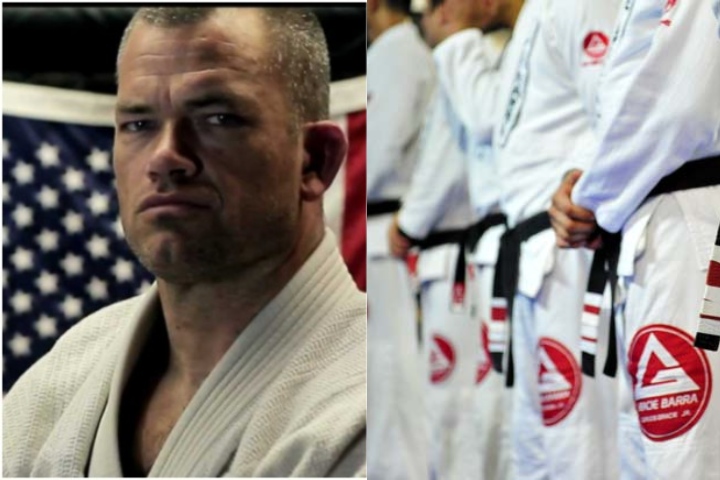
The goal of this post is not to compare which is better or more efficient, Judo VS BJJ.
Rather to show that Judo and BJJ are more comparable than they are various.
It is mainly the original goal or purpose for the establishment of the arts as well as their modern-day guidelines sets that distinguish the two; Judo VS BJJ.
But they are in essence more similar than different.
This development of the arts and their designated goals likewise result in the distinction in expression of the two in their competition and training today.
So while much of the techniques, training and even terms might be similar, it is the focus of the two arts and the function of their facility that has resulted in the significant distinctions we see today in between Judo vs BJJ.
Historic Roots
The present Olympic sport of Judo and the popular sport and martial art of BJJ or Brazilian Jiu Jitsu both have their roots in the battlefield Japanese combating systems referred to as Jiu Jitsu.
Both Judo and BJJ concentrate on grappling and are drawn straight from the battlefield Jiu Jitsu methods used in the warring duration of Japan.
Japanese samurai were well versed in Jiu Jitsu also weapons systems consisting of archery and horse riding.
Jiu Jitsu developed as essential unarmed techniques for a Samurai who lost their weapon and horse in battle.
Grappling, joint locks, chokes and strangles were established in order to conquer the light but hard protective armour used by Samurai which negated the benfits of striking martial arts strategies.
While Judo and BJJ draw their roots from the Japanese battlefield Jiu Jitsu; the path from Samurai battleground methods to Judo and BJJ practiced today are quite various.
Simply put Kodokan Judo established straight from various styles of deadly Jiujitsu and focussed more on the grappling elements. Gracie Jiu Jitsu or BJJ BRazilian Jiu Jitsu originated from Kodokan trainee, Mitsuyo MAeda.
Maeda was a groundwork specialist and regularly battled challengers of various styles who were typically larger than him.
Lets appearance in more information at the origins of Judo VS BJJ below.
Origins of Kodokan Judo
Kodokan Judo is essentially the same Judo seen in Olympic sport Judo the world understands today. There are naturally distinctions in Judo across the globe with unique Europe's. Style, Korean, traditional Japanese style and Merican Judo.
However all Judo today acknowledge Kodokan Judo as their root.
Kodokan Judo was established by Jigoro Kano in 1882.
Before developing Kodokan Judo, Kano was a determined and dedicated student of conventional Japanese Jiu Jitsu that was utilized in warring durations of Japan
His devotion and interest led Kano to become a Maser trainer in various schools of Jiu Jitsu at a really young age.
Numerous Schools of Jiujitsu in Japan.
At the young age of 19, Kano became the Master of the Fukuda Dojo where he initially started training Jiu Jitsu under his firts Jiuj Jtsu instructor Hachinosuke Fukuda.
This wanted the unforeseen death of Fukuda and demand by Fukuda's family that Kano prosper his Master as the dojo head.
Fukuda's dojo represented a mix of two diffrent schools of Jiu Jitsu which was the "yoshin ryu" and the "Shin ni Shinto ryu".
It must be understood that in Japan Jiu Jitsu is an umbrella term for many different schools or designs of martial arts.
Kano advanced his martial arts study and knowledge by also ending up being a Master trainer in the "Tenjin Shinyo ryu" school under Masamoto Iso.
Kano soon recognized that each school of Jiu Jitsu had unique strengths and he began to study various style in depth.
Kodokan Judo is Born
In 1882, Jigoro Kano opened his own school, calling his art "Kodokan judo".
By altering the name, Kano intended to distinguish his teachings from standard Jiu Jitsu which was a total battle system used by the Samurai on the battlefield.
The term Kodokan equates to indicate ko (lecture, research study, technique), do (way or path), and kan (hall or location). Thus it indicates "a place to study the way".
The Kodokan had 3 broad goals: physical education, contest proficiency and mental training. In establishing his Judo, Kano also started to incorporate the concepts of character, body, and mind advancement into the viewpoint of Judo.
Judo vs BJJ
Professor Kano became the first Asian member of the International Olympic Committee in 1909 and worked for the spread of Judo throughout the world.
Judo became a main event in the Olympic Games of Tokyo in 1964.
Origins of Gracie Jiu-jitsu/Brazilian Jiu-jitsu
The historic roots of BJJ started with one of Kanos leading trainees Mitsuyo Maeda.
Mitsuyo Maeda was born in 1978, in Funazawa Village, located in Hirosaki City, in the Japanese prefecture of Aomori. MArtial arts and battling belonged of his household custom as he was the son of a sumo fighter.
Mitsuo Maeda began training at the Kodokan in 1894, ultimately turning into one of Kano's leading students. While skilled in throws and take downs, Maeda's specialty was ground fighting or newaza.
Maeda was likewise a happy advocate of the real fighting and self defense applications of Kodokan Judo.
Maeda and other Kodokan masters began to travel the world demonstrating the efficiency of their Judo versus bigger and more powerful opponents by removing size and strength benefits through taking the battle to the ground and applying newaza methods and methods.
In 1914, Maeda traveled to Brazil, where he befriended an entrepreneur named Gastão Gracie. Maeda would ultimately accept Gastão's child, a teenager name Carlos Gracie, as his trainee.
Carlos would start teaching in Brazil and his more youthful brother Helio would likewise discover the Judo taught by Maeda.
Eventually Helio Gracie would establish his own expressions of the methods taught in Judo.
This lead the development of Gracie Jiu Jitsu and the BJJ that we know today.
Resemblances-- Judo VS BJJ
Jiu Means 'Gentle'.
The typical roots of Judo and BJJ appear in the character Jiu or Ju in both martial arts names.
This jiu/ju represents gentleness or replying less on strength and force and more so on technique.
In BJJ the idea of utilize is a structure which is also part of any Judo toss.
By making use of the larger muscle groups of the legs and hips a smaller sized person has the ability to efficiently perform BJJ techniques on a larger stronger challengers.
Judo vs BJJ.
The off balancing or kuzushi that is the structure to any Judo toss also is essential for BJJ in carrying out sweeps and gaining a superior position.
Both these key principles of leverage and off-balancing a challenger are also associated with jiu/ju as force, size, strength or perhaps hostility is bit necessary to carry out these reliable martial arts strategies.
Randori and Rolling.
A distinct element of Kano's art, which would eventually happen called Judo, was its emphasis on live sparring, likewise referred to as randori.
Through randori, Kano's trainees practiced throws, takedowns, joint locks, and chokes versus resisting opponents.
Judo's execution of randori represented a significant departure from the dominating training philosophy of the time, which favored compliance-based drilling over full-contact sparring.
This is the technique also used by BJJ schools in contemporary times where the live sparring is referred to as 'rolling'.
In contrast to other martial arts, particularly striking base darts, where it can be risky to spar hard every training session, the more grappling and submission based techniques of BJJ and Judo make difficult sparring safer and can be done every training session.
Both Judo & BJJ are Great for Self defense.
Bjj is well acknowledged as a suitable self defense and the screen og BJJ in popular MMA battles shows the efficiency of the art.
Judo has actually developed to become more Olympic sport oriented in its mentor and training.
However self defense is still part of the higher levels of Judo knowing and nage no kata is still needed at high levels of black belt dan ranking.
BJJ of more specifically Gracie Jiu Jitsu came from form Kodokan Judo. All BJJ is stated to be drawn from Gracie Jiu Jitsu that was established by Helio and his brother Carlos Gracie.
Many people argue that judo is much better for stand up grapplin and BJJ the ground.
Others state that Judo trains bothe ground (newaza) and standup so is more complete. It is true that lots of sport oriented schools focus less on stand grappling and more on guard and ground strategies.
Nevertheless the gracie schol and original gracie self-defense still pays terrific detail to take downs and stand up grappling in its base strategies.
The Samurai Spirit.
The battling spirit of the Samurai exists in both martial arts to an excellent extent.
Olympic Champion Kosei Inoue is understood for displaying the heart of the Samurai in all his competitors. Notably when ahead on points, Inoue was still known for going for the fight ending ippon and running the risk of a loss.
Rickson Gracie probably displays the heart of the Samurai more than any other Jiu Jitsu specialist. His famous battles such as his defeat of the huge Rei Zulu at just 21 years of ages, make him a legend of Jiu Jitsu in the modern-day age.
Both Judo and BJJ originally just used white gis.
White represents death in Japanese culture and Samurai used white under their armor signifying they were ready to pass away each time they went to fight.
This is likewise represented in both Judo and BJJ white gis. Blue gis emerged out of competition and to make judging and spectating much easier.
Distinctions.
Gracie Jiu Jitsu/BJJ Has More of a Self Defense Focus from the Beginning.
A significant distinction between Judo and BJJ remains in the real life application of strategies for self-defense.
Even within BJJ itself this distinction is made with the Traditional Gracie schools focussing on self defense first.
The sporting and pleasurable rolling or randori is secondary to street applicable self defense.
If self development using Judo as a significant tool toward that goal, Judo was developed by Jigoro Kano as a system.
Self defense and specifically the nage no kata is not the focus for anybody starting Judo. This is also real for BJJ schools that focus on sport competition.
Standard Gracie Jiu Jitsu focuses in self-defense from the beginning.
In Judo it come at completion at greater levels of black belt. Generally after an individual's competitive profession is currently over as a Judoka.
Accessibility of fitness centers Judo vs BJJ.
As an Olympic sport with a fairly long world history going back to the 1964 Tokyo games, Judo has a long recognized history in lots of countries around the world. From Africa, Europe, North and South America, Asai and Oceania there are Judo gyms to find out and train at.
BJJ by comparison got popularity following the UFC competitions in the early 90s.
And truly it has actually grown a lot more since the UFC became popular, and MMA fighters have made BJJ popular in the mainstream.
It is absolutely most likely that you will discover a Judo health club over a BJJ gym in the majority of the World today. This is even more so in establishing nations where World Judo has actually targeted specifically for assistance for many years.
Judo vs BJJ: Which to find out?
It depends a lot on your goals and the accessibility of schools and teachers you can access.
Then Judo and sport BJJ are good choices, if you want to contend regularly. If self-defense if your primary goal or perhaps MMA then Gracie Jiu Jitsu and affiliated schools focus more on 'facing punches' which is extremely various from sport BJJ.
As talked about above Judo gyms are probably more offered world large over BJJ gyms. This is especially so in establishing nations across Africa, Asia and Oceania.
So for many individuals Judo is a better choice as gain access to is quicker offered and likewise most likley more affordable than BJJ classes in a lot of cases.
Judo is Still Great Real World Fighting.
Even finding out the sport element http://kameronoimb257.fotosdefrases.com/some-professional-guidance-on-details-in-judo-for-self-defense of judo will assist anybody with self-defense.
Skilled fighters such as Ronda Rousey, Karo Parisyan and naturally Mitsuyo Maeda himself all combated successfully with a strong structure in Kodokan Judo.
The regular sparring (randori) in Judo together with strategies that a smaller sized individual can carry out on a larger individual make judo terrific genuine life grpaploing and self-defense.
Even being able to pin somebody to the ground until they gas out and submit is a major part of judo newaza and highly applicable to self defense.
https://en.search.wordpress.com/?src=organic&q=judo for self defense